
Bannock County Criminal Court Cases
Bannock County criminal court cases divide between the District Court and its Magistrate Division. District Court tries felonies. Magistrate judges hear misdemeanors and infractions, conduct initial felony appearances, and decide whether probable cause supports sending a felony forward after a preliminary hearing. Both lanes operate within Idaho's Sixth Judicial District at the Bannock County Courthouse. The prosecutor's referral is not itself a court charge. A complaint, information, or indictment must be filed before the allegation becomes part of a Bannock County court case.
The Clerk of the District Court keeps the judicial file. Criminal Court Information in Room 108 helps with case questions, while the Clerk's Office in Room 211 receives judicial record requests. Archives in Room 107 handles older material. These counters serve different needs, so a case number and the exact document name save time. City misdemeanors from Pocatello, Chubbuck, and Inkom also reach the county Magistrate Division. No separate city case-search portal replaces iCourt.
Bannock Court Lanes Explained
A felony often starts before a magistrate. The court states the charge and rights, addresses counsel and release, then may hold a preliminary hearing. If the matter advances, District Court receives the felony for arraignment and later proceedings. A misdemeanor normally stays with the Magistrate Division. Idaho does not sort felonies into a simple Class A, B, or C scheme, so the filed statute and its stated penalty matter more than a class label.
The official Sixth Judicial District directory identifies the clerk, criminal counter, archives, and courtrooms. It also shows why a reader should not treat every entry as the final result. A complaint is an accusation. A disposition is the outcome of a charge. Judgment and sentencing entries record what the court ultimately ordered.
The directory image below provides a visual check on the Bannock County court offices discussed here.
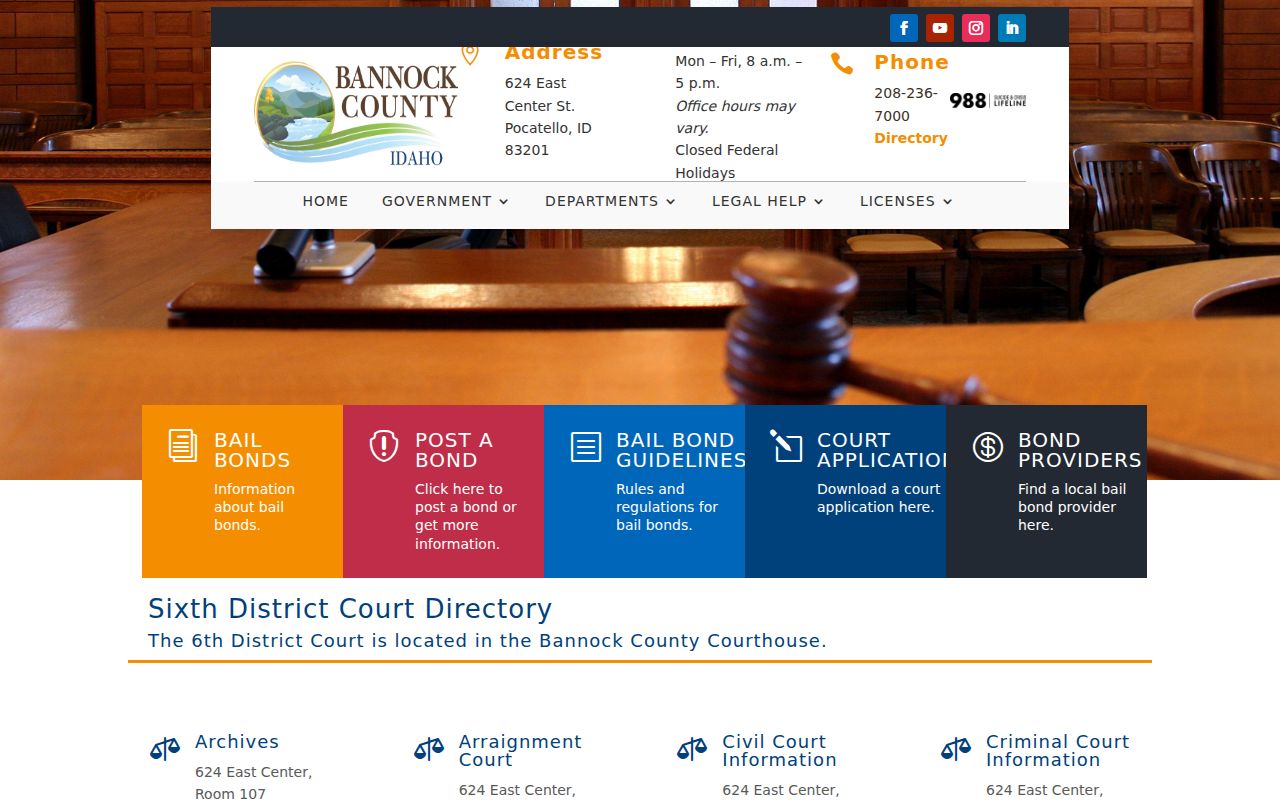
Its counter layout helps route a docket question to the office that actually holds the requested Bannock County record.
Searching Bannock County Case Records
The Idaho iCourt Portal is the first public index for Bannock County criminal case records. Smart Search accepts a complete case or record number or a party name. Wildcards and advanced filters can narrow results. Older numbers may need a format change, including removal of zeros after the case type and year. A portal result supplies public index and docket data, but it does not guarantee that document images are available online.
- Open Smart Search and choose a case-number or party-name search.
- Enter the full Bannock County case number when known. Try the documented legacy format adjustment if no match appears.
- For a name search, use spelling variants, wildcards, and available location, type, status, or date filters.
- Open the matching case and read charges, events, hearings, financial entries, and disposition in sequence.
- Request the needed pleading, order, judgment, certified copy, or audio from the Bannock clerk.
| Field Label | Type | Required | Notes |
|---|---|---|---|
| Search input | Text | Yes | Case or record number, or party name |
| Search type | Mode or tabs | One mode | Case number or party name |
| Advanced filtering | Expandable | No | Location, type, status, and date controls vary by portal version |
| Wild card | Text operator | No | The official tutorial demonstrates wildcard name searches |
| Submit or clear | Buttons | Submit | Runs or resets the search |
Bannock iCourt Search Details
Case numbers used for payment lookup may appear with or without dashes. The official examples include forms like CR-01-2016-1234 and CR0120161234. Party-name payment lookup requires last name, first name, and date of birth. Business-name lookup expects the name as filed. Mandatory-appearance matters cannot be paid online before appearance, collection-status matters use another path, and sealed cases are not payable through the public portal.
The official iCourt public-search tutorial shows the search modes and filters.
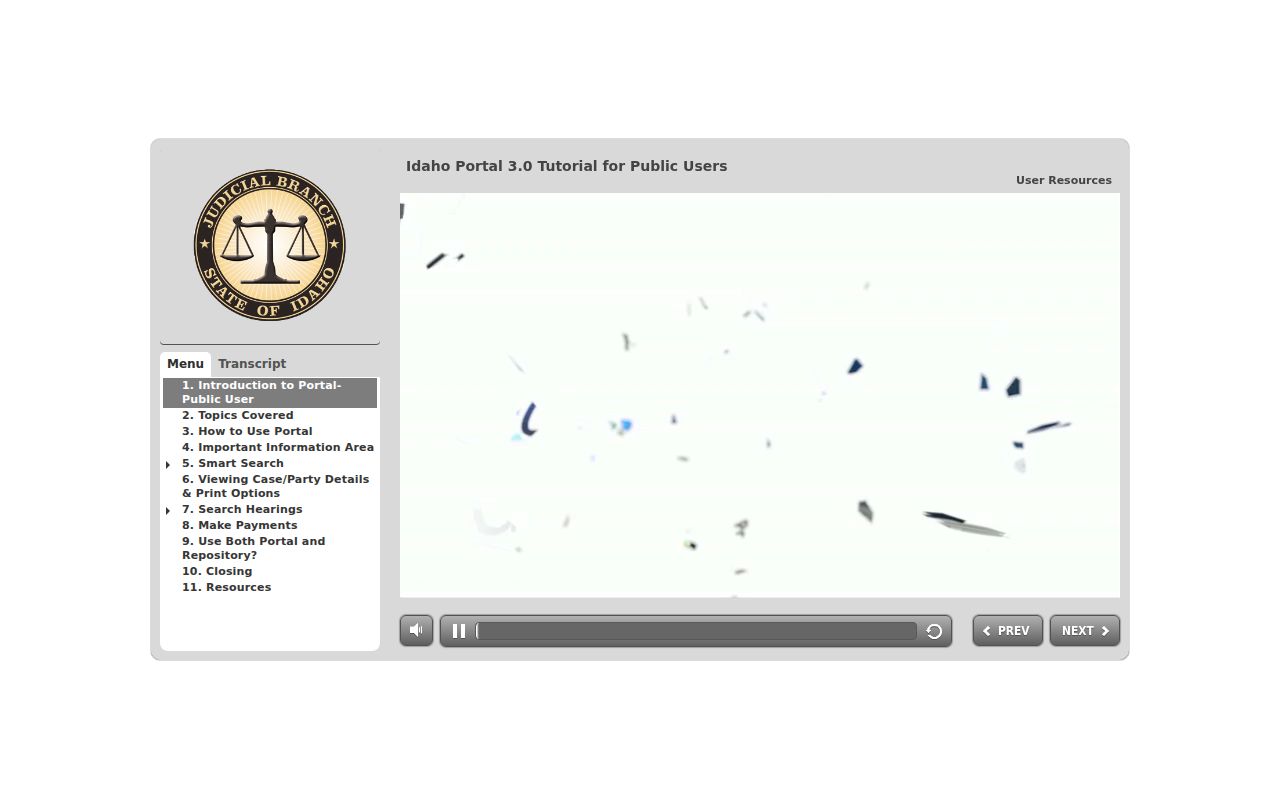
The tutorial is useful when a Bannock County case number, wildcard, or older format does not behave as expected.
Inside a Bannock County Case File
A Bannock County criminal case file records what prosecutors filed and what the court did. It is broader than a booking entry. The public register may show metadata even when an image cannot be opened online. The clerk supplies public copies. A reader tracing the outcome should compare each charge with its disposition rather than assuming that the first filed count survived unchanged.
| Case Number and Court | Identifies the Bannock location, case, filing date, type, status, and public judicial assignment. |
|---|---|
| Charging Document | Complaint, information, or indictment stating the filed accusation and statute. |
| Docket Entries | Chronological record of pleas, motions, notices, orders, and other events. |
| Hearing Dates | Event type, scheduled time, courtroom, judicial officer, and status when public. |
| Disposition and Judgment | Dismissal, acquittal, conviction, or other outcome for each charge. |
| Sentence and Conditions | Custody, probation, fines, restitution, and related orders after conviction. |
Bannock Court Copies and Audio
The Bannock Judicial Records Request form separates ordinary documents, certified documents, and FTR hearing audio. It asks for the case number, case name, precise document or hearing date, and delivery by pickup, email, or mail. Publicly listed charges are $1 per page and $1 per certification stamp. Audio costs $10 per CD, jump drive, or hearing, with added media costs possible. Postage and a deposit may also apply.
FTR audio is a listening copy, not an official transcript. When a filing requires a citable transcript, ask the clerk about the correct transcript process. The official Bannock criminal court page explains local hearings and access.
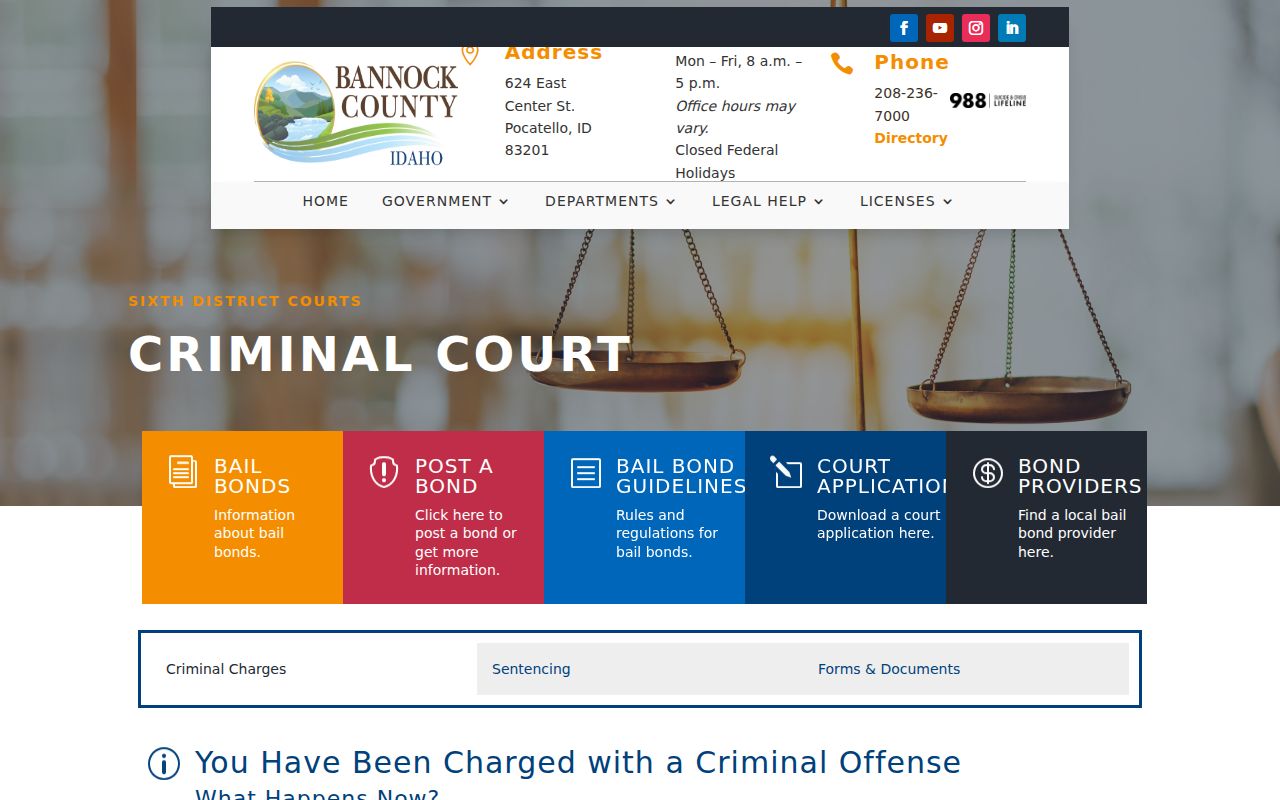
That local source connects the record request to the actual Bannock County criminal process.
How a Bannock Case Moves
After a law-enforcement referral, the Bannock prosecutor decides whether and what to file. An arraignment states the filed charge and addresses a plea. Pretrial work can include motions, discovery, negotiations, and hearing settings. A plea or trial produces a result, followed by judgment and sentencing when there is a conviction. Appeals create a later review layer. The sequence matters because booking allegations may change before filing, and filed charges may change again before judgment.
Case flow: Charges Filed › Arraignment › Pretrial › Plea or Trial › Disposition › Sentencing
Bannock Charges and Counsel
The Bannock County Prosecuting Attorney reviews referrals and represents the state, but the clerk remains the record custodian.
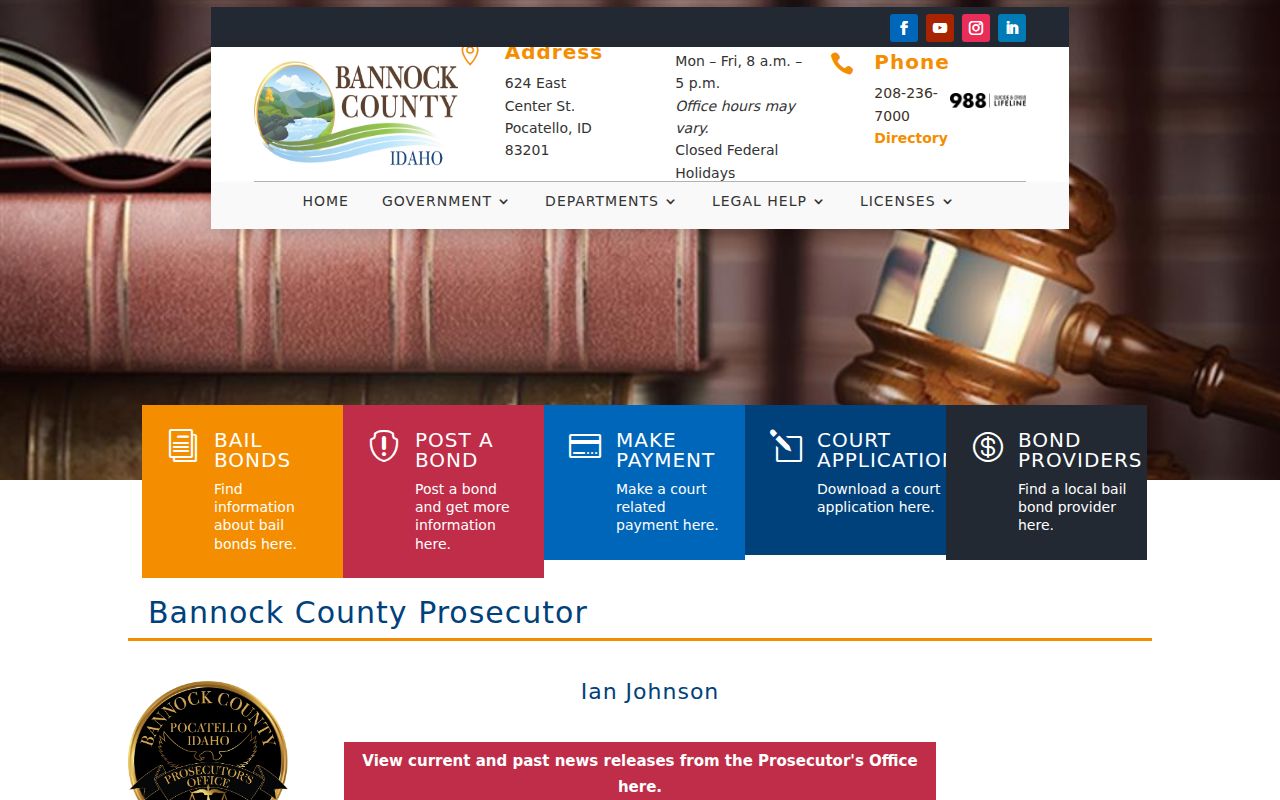
The prosecutor source helps distinguish a submitted police referral from a filed Bannock County court charge.
The Bannock County Public Defender explains appointment and warrant guidance for eligible defendants.
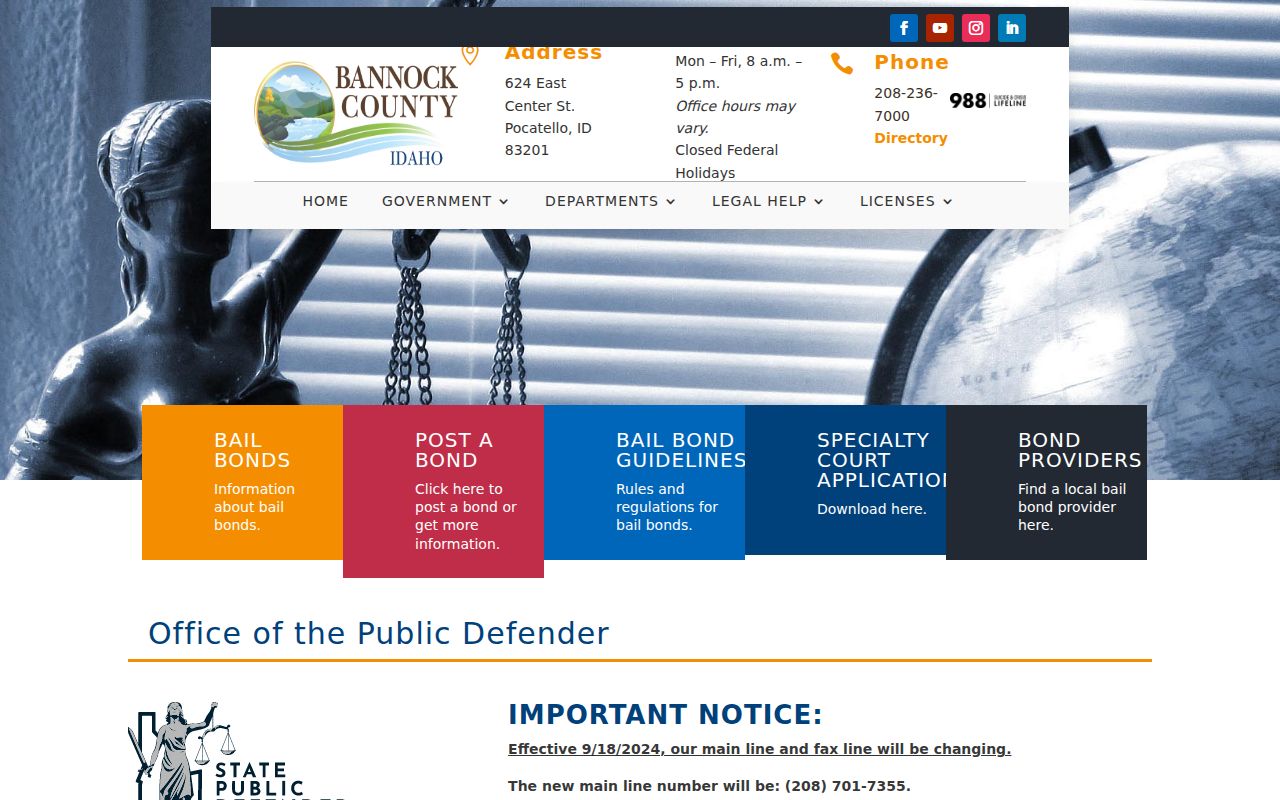
Its role is representation, not public record custody, so case copies still come from iCourt or the clerk.
Bannock Archives and Clerk Counters
When Smart Search does not locate an older Bannock County criminal case, contact Criminal Court Information at 208-236-7271 or Archives at 208-236-7279. The courthouse is at 624 East Center Street, Pocatello, Idaho 83201. Clerk public hours posted for August 2026 are 8:00 a.m. to 4:45 p.m. weekdays, excluding holidays and emergency closures. Room 108 handles criminal information, Room 107 handles archives, and Room 211 is the clerk request point.
Bring the case number, party name, approximate filing year, and document description. Courtroom camera, audio, and video use requires prior written judicial approval. Request a clerk copy instead of assuming a phone photograph is allowed. Interpreter help is available to a participant who cannot speak, hear, or understand English, with advance notice to the clerk.
Courthouse security also affects an in-person Bannock County records visit. County instructions advise visitors to bring only a pen, paperwork, and money, while leaving bags and electronic devices in the car. Weapons are barred. The east-door Sixth Street ramp provides an accessible entrance. A payment dropbox on East Center is checked in the morning and afternoon, but a dropped payment is not a request for a case file. Direct document questions to the criminal counter or clerk.
For a file that has moved to archives, give staff enough detail to separate people with similar names. An approximate year, former case-number format, charge description, and known hearing date can help. If the goal is to prove the outcome, ask for the judgment, dismissal order, or other final disposition rather than every page. Certification adds the clerk's formal stamp to the requested copy. It does not change what the court decided.
Bannock Case Access and Restrictions
Idaho Court Administrative Rule 32 controls access to judicial records. Public Bannock County dockets may include party indexes, charges, events, calendars, orders, and judgments. Sealed cases, juvenile matters, protected identifiers, presentence or risk reports, protected victim information, and other exempt material may be withheld or redacted. A no-result screen is therefore not proof that no Bannock County file exists.
Ask the clerk whether the number format, spelling, archive status, or access rule explains the missing result. The broader Idaho Public Records Act does not replace Rule 32 for court files. If a request is denied, the judicial form describes review by the custodian judge and possible court challenge. An arrest entry can remain even after a court dismissal. For the custody side of that trail, use the county Bannock County arrest lookup, then return to the case disposition for the judicial outcome.
Public access also differs from repository access. Idaho State Police BCI receives reportable arrest and disposition information for the central criminal-history record, while the Bannock clerk keeps the judicial documents. A court disposition can complete a BCI arrest cycle, yet the actual signed order still belongs in the clerk's case file. When a BCI record appears incomplete, obtain the Bannock County order first and use BCI's fingerprint-based accuracy challenge route.