
Checking Criminal History in Bannock County
The most useful first stop depends on the record. Idaho iCourt Smart Search provides public trial-court party and case information statewide. The Bannock County Sheriff App carries the county's current jail roster and Daily Activity Reports. A written request through the county records-request hub reaches Sheriff, general county, or judicial custodians when the online sources do not supply the needed document.
- Choose the custodian by asking whether the need concerns an incident, booking, court case, statewide history, or correctional status.
- Gather a full legal name, date of birth when available, spelling variants, and a case or report number if one is known.
- Search iCourt by exact name or case number, then broaden with a wildcard or alternate spelling if the first search is empty.
- Compare dates, court location, charge, and disposition before treating a result as a match; a name alone is not a reliable identifier.
- Request the underlying report or certified court copy, or order a BCI fingerprint report when identity certainty is important.
Four Bannock Systems, Four Answers
Bannock records divide along the event timeline. The Sheriff app answers who is in the Detention Center and what recent activity the agency reports. iCourt answers whether a prosecution was filed and how the judicial file progressed. The Idaho State Police Bureau of Criminal Identification, or BCI, joins reportable Idaho arrest cycles with submitted dispositions in the central repository. The IDOC Resident/Client Search answers whether a person is in state custody or under felony probation or parole supervision.
The Bannock County government gateway routes readers to the Sheriff, courts, prosecutor, defender, and records offices.
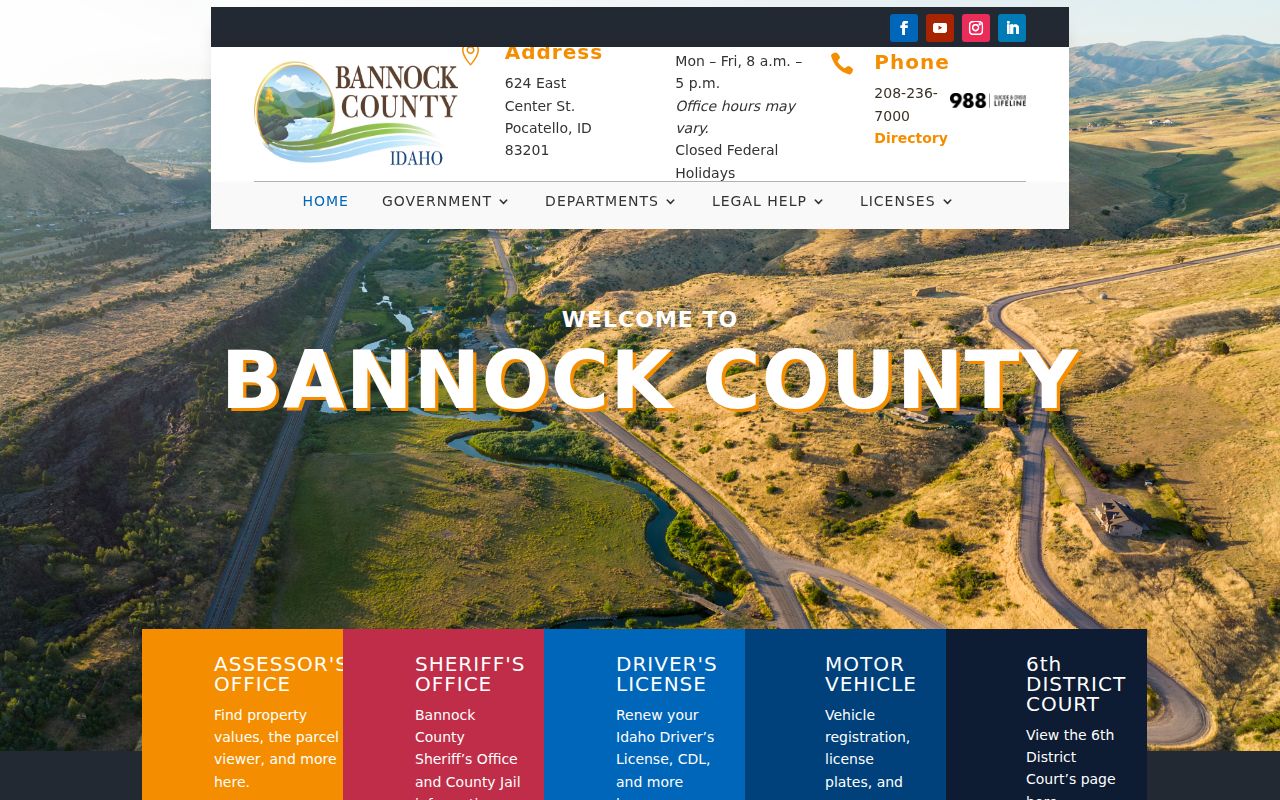
That department-level routing helps identify the office that created the desired record before a request is sent.
| Question | Official channel |
|---|---|
| Current county custody | Bannock Sheriff App and Detention Center |
| Filed case and outcome | Idaho iCourt and Bannock Clerk |
| Official Idaho history report | ISP Bureau of Criminal Identification |
| Prison or felony supervision | IDOC Resident/Client Search |
No result in one lane settles the others. A recent arrest may not yet have produced a filed case. A dismissed case can coexist with a historical booking entry. A county jail release does not show whether IDOC later received the person. Checking the lane that owns the event is the reliable approach.
Idaho Official Background Checks
BCI operates the Idaho Central Repository of Criminal History Records. Idaho does not offer an instant public conviction-name portal. Instead, a person can submit a name-based or fingerprint-based request; requests are delivered or mailed, and name requests may also be faxed, while results are returned by mail. A name check costs $20 and is less certain because aliases, false birth dates, and similar names can affect matching. A waiver is not required by Idaho law, but an eligible waiver that is no more than 180 days old affects whether an older arrest without a disposition may be released to a non-criminal-justice requester.
A fingerprint report is the stronger self-review channel. The requester supplies an inked-and-rolled applicant card, the BCI form, and payment. Effective January 1, 2026, the Idaho fingerprint-based check is $25; national products have separate fees. The Bannock County Sheriff lists fingerprinting at $5 per card, which is a rolling service fee rather than the BCI search fee. BCI also provides a challenge process when the subject believes a repository entry is inaccurate or incomplete.
The ISP BCI request page supplies the current forms, mailing route, and instructions for both methods.
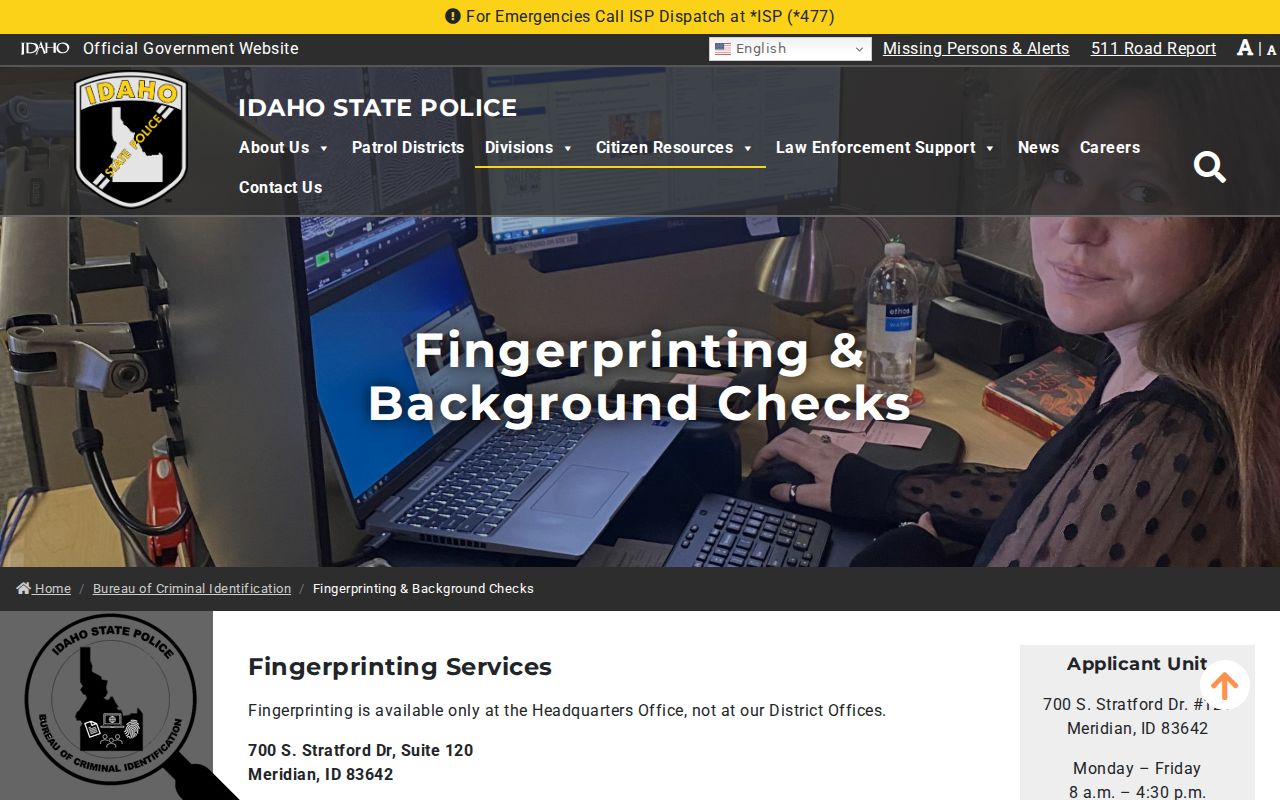
The official form route matters because BCI does not send results by email or provide an instant public name portal.
Bannock's Sheriff App Replaced the Web Roster
The old web roster that refreshed every four hours is obsolete. In 2026 Bannock County moved the inmate list into the Sheriff App, alongside Daily Activity Reports, alerts, tips, and an interactive sex-offender tool. The distinction matters: the current roster is app-only, so an old bookmark may fail even though the county still publishes custody information. The Detention Center's main line, 208-236-7125, is the fallback when a new booking does not appear or custody status needs confirmation.
The Bannock County Sheriff page remains the official contact and records-request starting point.
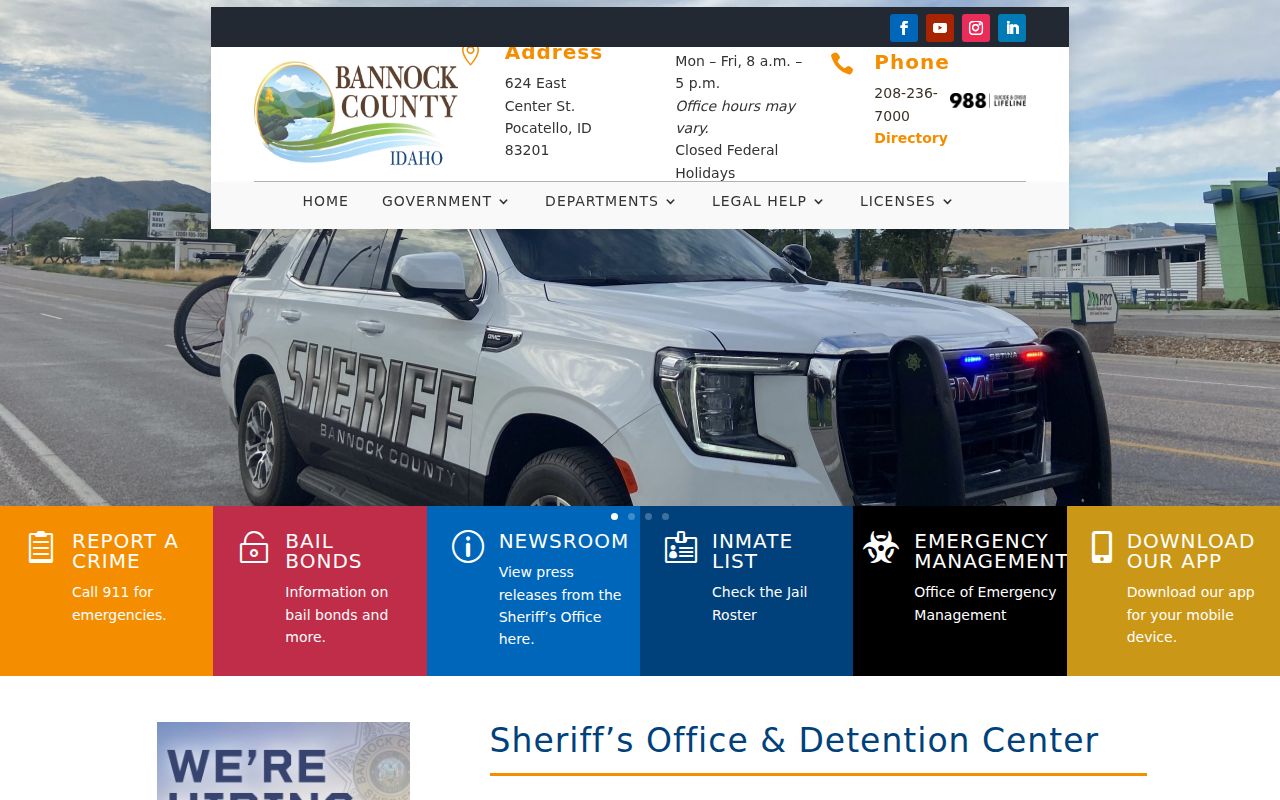
The app handles current roster access, while the Records Bureau handles releasable historical Sheriff material.
The roster describes detention, not guilt. Holding charges may change after review by a prosecutor, and the court, not the jail, records a dismissal, plea, trial result, or sentence. Historical booking or Sheriff-created incident material should be requested in writing through the Sheriff records channel. For a person transferred into state custody, switch to IDOC's locator rather than expecting the county roster to preserve a current status.
Criminal Record Types
A criminal history search becomes clearer when each record is tied to its creator. Bannock law-enforcement agencies create incident and arrest reports. The Detention Center creates booking and custody records. The prosecutor's filing produces a judicial case in the Sixth Judicial District. The clerk records events and dispositions, while BCI and IDOC receive selected information for statewide repository and correctional purposes.
- Arrest and booking records document custody, intake, holding charges, bond or release status, and facility movement.
- Criminal court files contain complaints, information, hearing events, orders, financial entries, and the judicial outcome when public.
- Repository history joins reportable Idaho arrest cycles and dispositions reported to BCI, subject to dissemination rules.
- Warrant information may appear through the issuing court; Bannock has no general public Sheriff warrant portal, so iCourt, the clerk, and direct agency confirmation form the practical chain.
- Supervision and registry entries come from Bannock misdemeanor probation, IDOC felony supervision, and the Idaho Sex Offender Registry under separate legal rules.
The Bannock Clerk Counter Map
The Bannock County Courthouse at 624 East Center Street in Pocatello separates tasks by counter. Room 108 is the criminal counter, Room 107 handles archives, Room 211 receives judicial record requests, and Room 215 handles bonds and fines. Choosing the correct counter avoids treating the courthouse as a single undifferentiated records desk. Public clerk hours are posted as 8:00 a.m. to 4:45 p.m. weekdays beginning August 1, 2026, excluding holidays or emergency closures.
Visitors enter through security screening. The east-door Sixth Street ramp provides an accessible entrance. Courtroom recording and camera access follow judicial rules and approval requirements; a public court file is not permission to record a proceeding. The Sixth District directory lists the clerk counters, judges, court services, and department contacts. For a file not found online, the archive counter or a judicial records request may be more productive than repeating the same iCourt search.
Inside a Bannock County Criminal Record
The fields depend on the product. A court result may identify a party and case number, filing date, charge wording and statute, register of actions, financial entries, and disposition. A jail record emphasizes booking and release. A BCI report organizes arrest cycles and reported outcomes. Reading the source label and date is as important as reading the charge.
| Name & Identifiers | Legal name and available matching details; confirm identity rather than relying on a same-name result. |
|---|---|
| Arrest / Booking Data | Arresting agency, intake timing, holding charge, booking status, bond, release, or transfer information. |
| Charges & Statutes | Filed offense wording, Idaho statute citation, severity, and counts; a holding charge may differ from the filed charge. |
| Disposition | Dismissal, acquittal, conviction, withheld judgment, or other court resolution where public and reported. |
| Sentence | Jail or prison term, fine, probation terms, and credited time when the order makes those details public. |
| Custody / Supervision | County detention, IDOC prison, felony probation or parole, or Bannock misdemeanor probation are maintained in different systems. |
Why iCourt May Show No Result
The official Idaho iCourt portal opens the statewide Smart Search interface.
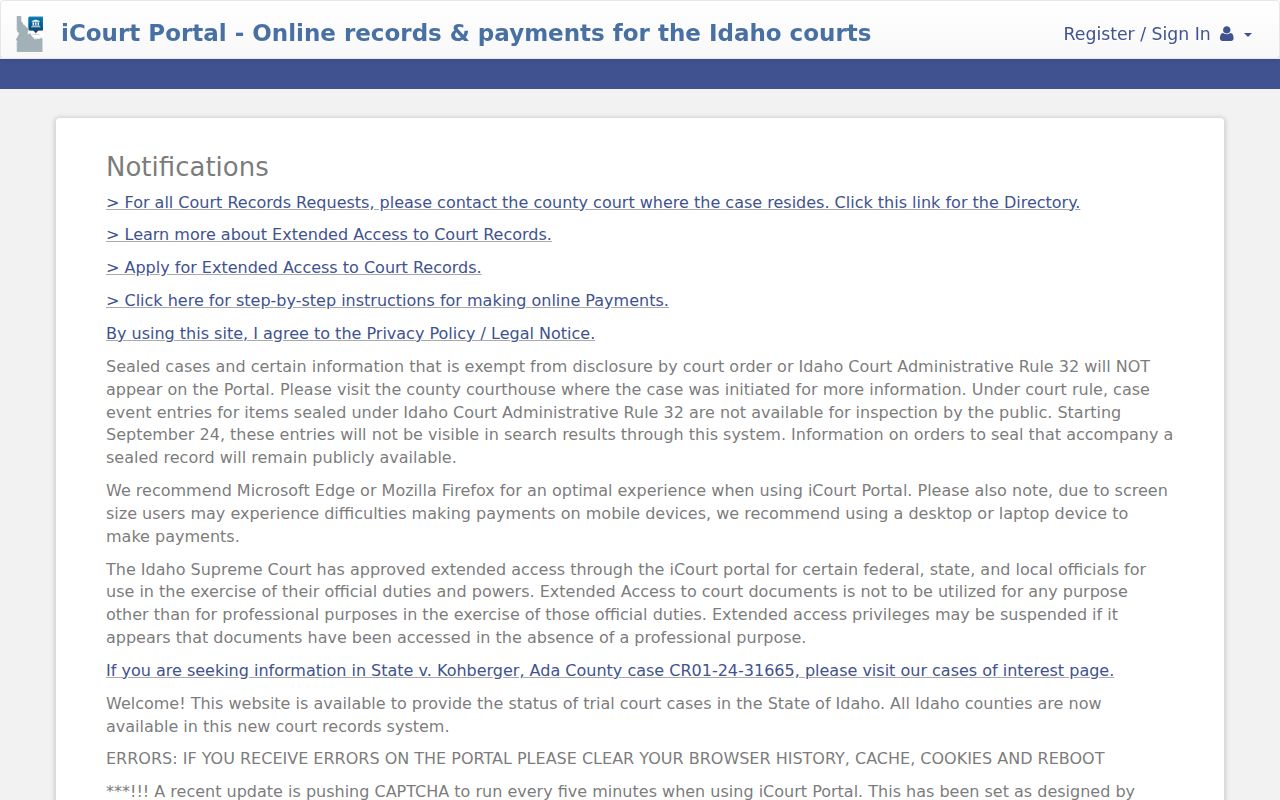
Smart Search is the statewide public case index, but not every judicial record is visible.
An empty Smart Search result is not proof that no record exists. Idaho Court Administrative Rule 32 removes sealed and otherwise restricted material from public view. A spelling variation, alias, legacy case number, recent filing delay, or search filter can also hide an otherwise public match. The official iCourt tutorial explains exact names, case-number formats, filters, and wildcard searching. Try a broader query, remove punctuation from a legacy number, and confirm that Bannock County is included.
If the file should be public but remains absent, contact the Bannock Clerk. A judicial request can identify the party, approximate year, case number if known, and the specific document needed. Older material may be in archives. Certified copies come from the filing county clerk; a portal screen is not a certified court record. Appellate and compiled-data requests use different Idaho Judicial Branch channels.
Public Access Laws in Idaho
The Idaho Public Records Act generally favors access to government records but preserves exemptions. Judicial access is governed separately by Rule 32. Criminal-history dissemination rules control what BCI may release, so a police report, court docket, and repository report can lawfully show different information. Under Idaho Code § 74-103 and § 74-113, agencies may charge permitted copying or labor costs and generally must grant or deny a request within three working days, or provide written notice when up to ten working days is needed.
Key Idaho authorities:
Idaho Code title 74, chapter 1 establishes the Idaho Public Records Act and its request framework.
Idaho Code § 67-3008 governs dissemination of criminal-history information from the state repository.
Idaho Court Administrative Rule 32 defines public, exempt, sealed, and restricted judicial records.
Idaho Code § 19-2604 provides qualifying set-aside or dismissal relief after certain probation outcomes.
Idaho Code title 18, chapter 83 governs sex-offender registration and community notification.
The Three- and Ten-Day Records Clock
A Bannock public-record request should describe the record rather than ask an agency to answer a broad question. Include the agency, date range, report or case number, people or location involved, and whether inspection or copies are requested. The county hub separates general county, Sheriff, and judicial forms because the recipient determines which legal and operational rules apply. Sending a court-document request to the Sheriff can add delay even when both offices are in the same county system.
The statutory clock concerns an agency response, not a promise that every document will arrive in three days. An office may grant access, deny access with a legal basis, or notify the requester that up to ten working days is necessary. Fees can reflect authorized copying and labor. Ask for an estimate when a request is broad, and narrow by date or document type when the estimate exceeds the value of the material sought.
The county's official records-request choices separate general, Sheriff, and judicial forms.
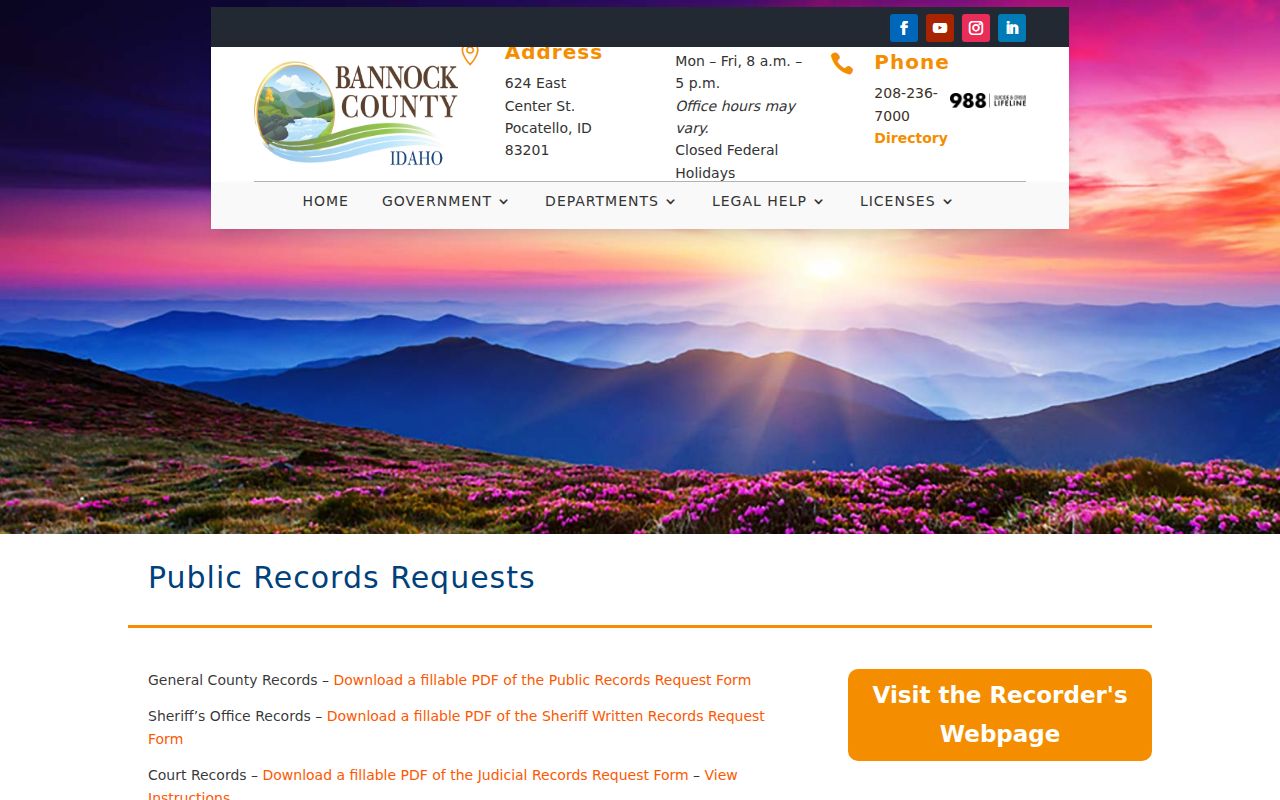
Selecting the matching form helps the request reach the legal custodian instead of an office that only uses the record.
Bannock Record and Fingerprint Fees
Fees belong to the service that performs the work. Paying the Sheriff to roll a fingerprint card does not pay BCI to search the repository. Likewise, a free iCourt search does not make certified copies free. Confirm current charges with the custodian before submitting payment, especially when requesting a large file or a national fingerprint product.
| Service | Published amount or rule |
|---|---|
| BCI name-based Idaho report | $20 |
| BCI fingerprint-based Idaho report | $25 effective January 1, 2026 |
| Bannock Sheriff fingerprint rolling | $5 per applicant card |
| Certified Bannock court copy | $1 per page plus $1 per certification stamp |
| Public-record copies or labor | Permitted charges depend on scope; request an estimate from the custodian. |
Sealed, Expunged, and Restricted Records
Idaho does not provide general adult conviction expungement. Relief depends on the record and legal authority. Juvenile records and limited non-conviction identification records may qualify for expungement. Some judicial records may be sealed under Rule 32. Idaho Code § 19-2604 can permit a qualifying guilty plea or conviction to be set aside after probation, while clean-slate shielding and other exemptions have their own effects. These remedies are not interchangeable and do not all destroy the BCI repository entry.
A sealed case normally disappears from public iCourt access but remains available to authorized officials. If a dismissed case still appears on a BCI self-review report, obtain the final court disposition from the Bannock Clerk and use BCI's fingerprint-based challenge route. The Prosecuting Attorney warns that adult relief is limited; legal advice may be needed to identify the correct remedy. A missing public search result therefore can mean restriction, not deletion.
Where Bannock Warrant Questions Go
Bannock County does not publish a general Sheriff warrant-search portal. A bench warrant may appear in the related public iCourt case, and the Clerk can explain how to obtain public case material. The Sheriff or the agency named in the case is the direct confirmation channel, but anyone trying to resolve their own warrant should avoid relying on an unofficial list or assuming that an empty name search clears the issue. The Bannock Public Defender advises that appointment and warrant questions depend on the case posture.
A warrant is a court or law-enforcement authorization, not a conviction. It may reflect an alleged offense or a failure to appear, and status can change after service, recall, or a new court order. Use the case number when available and verify current status with the originating office. A written Sheriff request may produce releasable historical material, but it is not a substitute for real-time safety or surrender instructions.
Federal matters use the U.S. District Court for the District of Idaho, not Bannock's state-court file.
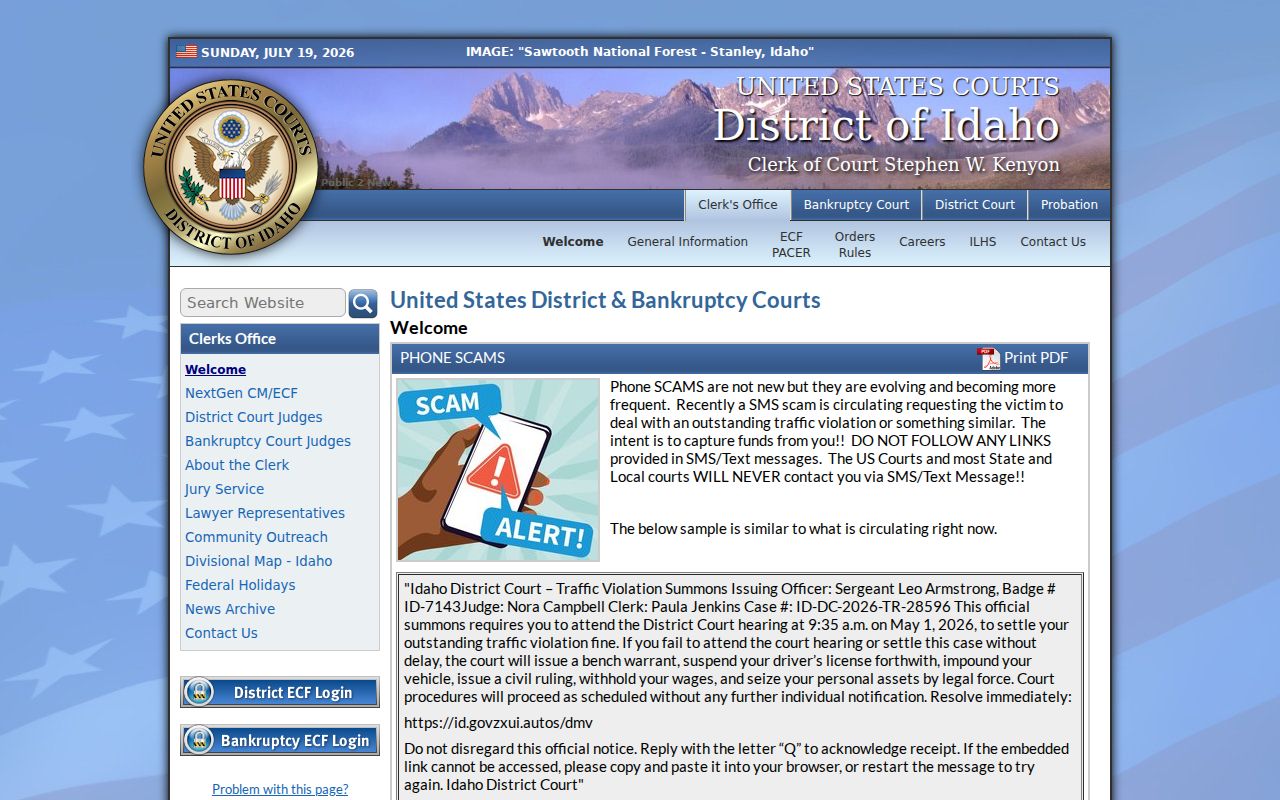
PACER and the federal clerk are the proper sources when a case was filed under federal jurisdiction.
Bannock County Criminal Records by City
City police reports remain distinct even though custody and court cases converge at county and state systems. Pocatello uses NextRequest for city and police records; Chubbuck requires its signed Police Records Bureau form; Inkom routes current incident and arrest contacts to the Bannock Sheriff. None has a separate municipal-court search: misdemeanor, traffic, and felony court information routes through the Sixth Judicial District and iCourt.
Pocatello Criminal Records
58,231 (2024 estimate) · NextRequest for Pocatello Police records; county booking and iCourt for later stages.
Chubbuck Criminal Records
16,577 (2024 estimate) · signed CPD request form, Bannock jail custody, and Magistrate or District Court cases.
Inkom Criminal Records
854 (2020 Census) · City Hall for administrative records and the Sheriff for present police services.
Crime in Idaho Numbers Are Not Convictions
ISP's 2024 Bannock jurisdiction sheet reports 5,319 Group A offenses, 2,469 clearances, and 3,858 arrests across participating county agencies. Those totals are reported events and arrests, not unique people or court convictions. The reporting population of 91,308 also differs from the Census 2024 estimate of 91,010, so the denominators should not be mixed. A 46.42% clearance figure means an agency cleared reported offenses under NIBRS rules; it does not mean that percentage resulted in a conviction.
Agency figures reflect jurisdiction and workload. Pocatello Police, Chubbuck Police, and the Sheriff's Office serve different reporting populations and produce separate records at the incident stage. Boundary differences make their raw rates unsuitable as simple measures of personal risk. For an individual matter, the report, booking, court disposition, and repository entry remain the relevant evidence, not a countywide statistical total.